

Many successful entrepreneurs began just like you, with a burning desire to build something of their own, to create an impact, to gain financial freedom, but with no concrete idea of what business to start.
They didn’t have all the answers. They weren’t born entrepreneurs.
Entrepreneurship is not just for tech geniuses or the wealthy. It is for anyone willing to explore, learn, and act.
This article will simply guide you through how to start a business from scratch, covering every step you need to take to turn your vision into reality.
Here are practical steps to follow to become an entrepreneur.
10 Ways to Become a Successful Entrepreneur
1. Ditching the myth of the “Lightning Bolt” Idea
The phrase refers to the common belief that successful business ideas (or creative ideas in general) arrive suddenly in a dramatic burst of inspiration like a lightning bolt striking out of nowhere.
People imagine entrepreneurs waking up one day with a perfect idea that instantly leads to success.
“The biggest myth in entrepreneurship is that you need the perfect plan before you begin. In reality, success comes from starting small, learning quickly, and adapting along the way.” Dr. Lisa Grant, Business Coach & Entrepreneurship Lecturer
Very few entrepreneurs wake up one morning shouting, “I have just invented Uber!” Instead:
- They solved a problem they faced.
- They spot gaps in the market where needs go unmet.
- They improve an existing product or service.
- They copy a proven business model and bring it to a new audience.
So relieve yourself of the pressure to dream up something revolutionary. The world doesn’t necessarily need the next Facebook. It needs people willing to solve everyday problems reliably and well.
2. Start with You: Your Interests, Skills, and Experience
When you don’t know what business to start, begin by looking inward, instead of chasing random trends or copying what others are doing. Make a “You” Inventory
Grab a notebook and brainstorm answers to questions like:
- What skills do I have? (writing, coding, cooking, teaching, organizing)
- What topics fascinate me? (fashion, health, tech, sports)
- What challenges have I personally overcome?
- What jobs have I held, and what parts did I enjoy?
- What activities do people often ask me for help with?
For example:
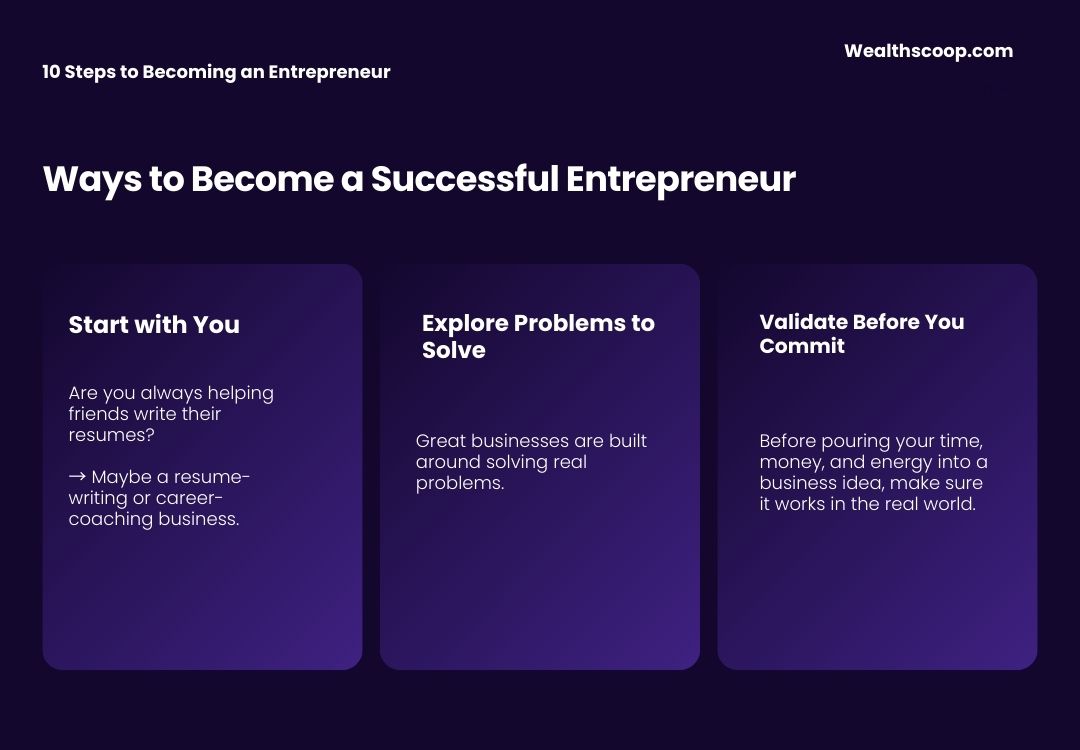
Are you always helping friends write their resumes?
→ Maybe a resume-writing or career-coaching business.
Do you love baking and get rave reviews on your cookies?
→ Maybe a home-based bakery or online cookie store.
Are you skilled at fixing gadgets?
→ Maybe a mobile electronics repair service.
3. Explore Problems to Solve
Great businesses are built around solving real problems. Once you have reflected on your interests and skills, the next step is to look outward at the world around you.
Businesses exist to solve problems.
The simplest way to generate ideas is to look for:
- Things people complain about
- Tasks people hate doing
- Products people wish existed
- Ways current solutions fall short
Start observing:
- Online forums (Reddit, Quora, Facebook groups)
- Product reviews on Amazon
- Conversations with friends, family, and colleagues
Write down problems you discover, even small annoyances. Those small annoyances are often big business opportunities.
4. Borrow and Adapt Proven Business Models
Here is an underrated secret: you don’t always have to invent something completely new.
You do not always have to invent something completely new to start a successful business.
Many thriving businesses are built by borrowing existing business models and adapting them to new markets, niches, or audiences.
- Freelancing: Offer services in writing, graphic design, consulting, tutoring, etc.
- E-commerce: Sell products online via Shopify, Etsy, or Amazon.
- Content creation: Build a YouTube channel, podcast, or blog.
- Subscription boxes: Curate monthly products around a niche.
- Digital products: Sell ebooks, templates, and online courses.
These models work because they have been tested, and millions of people pay for them. You can enter the same markets with your twist.
5. Validate Before You Commit
Before pouring your time, money, and energy into a business idea, make sure it works in the real world.
This step is called validation, and it is one of the most important (and most overlooked) parts of starting a business.
Once you spot an idea, do not rush to build a full business immediately. Test your idea cheaply and quickly.
Ask yourself:
- Are people already paying for this type of solution?
- Who are your potential customers?
- How can you prove there’s demand without spending a fortune?
Ways to validate:
- Talk to potential customers and gather feedback.
- Post your idea on social media and see who’s interested.
- Offer a simple service to your network.
- Create a landing page describing your product or service, and measure sign-ups or interest.
This reduces the risk of spending months (or years) on something nobody wants.
6. Start Small and Learn As You Go
When you are excited about a business idea, it is tempting to go big right away, spend lots of money, build a fancy product, or open a huge store.
But there’s a smarter, safer way: start small. You don’t have to use all your life savings on Day 1. Many businesses start as side hustles:
- A freelance writing gig after work
- Selling crafts on Etsy
- Offering weekend tutoring services
- Walking dogs in your neighborhood
This allows you to:
- Test your idea
- Build confidence
- Earn money while still having financial stability
Remember: entrepreneurship is a skill you develop, not a personality you’re born with. Starting small helps you learn without huge risks.
7. Learn Business Basics
Even if you are passionate and have a great idea, running a business involves more than just selling a product or service.
Understanding the basics of how businesses work is crucial for long-term success.
If you’re new to entrepreneurship, there’s no shame in not knowing how to “run a business.” Luckily, you can learn:
- Business planning: How to outline your business model, pricing, and operations.
- Marketing basics: How to find customers, promote yourself, and build a brand.
- Finances: Budgeting, bookkeeping, understanding costs and profit margins.
- Legal requirements: Business licenses, taxes, contracts, and intellectual property.
Plenty of free resources exist:
- YouTube channels like Alex Hormozi, Graham Cochrane, or Foundr
- Websites like SBA.gov (U.S.), Gov.uk (U.K.), or your local small business agency
- Online learning platforms like Coursera, Udemy, and Skillshare
8. Have a Mentor
Mentors have already faced many of the challenges you are encountering.
They can share valuable insights, help you avoid mistakes, and offer guidance tailored to your situation. Learn from their experience
Find people who:
- Have started businesses themselves
- Understand your chosen industry
- Can answer questions or offer guidance
Ways to connect:
- Join local entrepreneur meetups
- Participate in Facebook or LinkedIn business groups
- Seek out small business development centers
- Find online communities in your niche
Learning from others shortens your learning curve and helps you avoid costly mistakes.
9. Get Comfortable Selling
Overcoming fear, awkwardness, or resistance around promoting your products, services, or ideas
One of the biggest hurdles for new entrepreneurs is selling.
Selling doesn’t mean being pushy. It means:
- Explaining how your product/service solves a problem.
- Believing in your value.
- Asking people to buy.
Practice talking about your business confidently. It might feel uncomfortable at first, but remember, people can not support you if they do not know what you are offering.
10. Embrace Failure as Part of the Journey
Accepting that mistakes, setbacks, and missteps are normal and even valuable parts of any worthwhile pursuit. Not every idea will work. That’s normal, even for seasoned entrepreneurs.
Instead of fearing failure or seeing it as a sign you’re not good enough, you treat it as feedback, learning, and fuel for growth.
The goal is not to avoid failure completely. It’s to:
- Keep failures small and affordable
- Learn from each attempt
- Try again, smarter
Often, your second, third, or fourth business attempt is the one that takes off. Don’t give up just because your first idea flopped.
Still unsure where to begin? Here’s a list of simple business ideas that often start small and can grow big:
- Social media management for local businesses
- Virtual assistant services
- Personalized gift or craft business
- Cleaning services
- Fitness coaching or meal planning
- Home organization services
- Pet-sitting or dog walking
- Copywriting or editing services
- Photography for events or products
- Digital marketing services
- Personal finance coaching
- Selling digital products (templates, guides, courses)
Start with one small service or product. It might be the beginning of something bigger than you ever imagined.
Final thought
Many people wait for the “perfect” time, more money, or special skills to start a business, but that moment rarely comes. Successful entrepreneurs often begin with what they have and grow from there.
Even limited savings can test a small idea, basic skills can improve over time, and a few community connections can be your first customers.
Use what’s in your hands, your phone, computer, and internet to solve problems or offer talents.
If you are unsure where to start, explore your skills, interests, and everyday problems, test proven models, and run small experiments.
The key difference between dreamers and doers is action. Start now, learn as you go, and you will build the business you have imagined.