


If you have ever thought about investing, you have probably faced the same dilemma as most beginners: Where do I even start?
Maybe you have been saving, and perhaps you are tired of low bank interest, and you have just realized that keeping cash under your mattress is not exactly a growth strategy.
The moment you start researching, you are hit with unfamiliar jargon, endless charts, and experts who all seem to have different opinions.
It can feel like stepping into a noisy marketplace where everyone is shouting about “the next big thing.”
But behind all the noise, two options keep coming up: stocks and bonds.
They are the foundation of most investment portfolios, whether you are starting small or already have some money to grow. The question is: Which one makes more sense for you right now?
In this guide, we will break it down in plain language so you can make a decision that fits your goals, personality, and risk tolerance.
What are Stocks?
Imagine a company, say, a technology firm like Apple or a local manufacturing company.
To grow, companies often need more money than they have in their bank accounts. One way they raise money is by selling shares of ownership to the public.
Each piece of ownership is called a stock or share. When you buy a stock, you become a partial owner of that company.
You are entitled to a portion of its profits (often paid as dividends), and you benefit if the company grows and its stock price increases.
Many investors prefer not to pick individual stocks but instead invest through funds. If that sounds like you, check out this beginner’s guide to investing in mutual funds and ETFs.
How is Money Made from Stocks?
1. Capital Gains
You buy a stock at $100 and sell it later at $150. That $50 profit is called a capital gain.
2. Dividends
Some companies pay part of their profits back to shareholders as cash payments. This is extra income, even if you do not sell the stock.
Benefits of Investing in Stocks
Higher Potential Returns
Historically, stocks have provided higher long-term returns than most other investments. For example, the average annual return of the S&P 500 (a stock index) has been about 8–10% over the long run, though it fluctuates year by year.
Ownership
You are a part-owner of companies whose products you love and use. Imagine earning profits from brands like Coca-Cola, Microsoft, or your favorite local bank.
Beating Inflation
Inflation eats away at the value of money over time. Stocks tend to grow faster than inflation, protecting your purchasing power.
Liquidity
Stocks are easily bought and sold on the stock market, allowing you to access your money quickly if needed.
Diversification
Investing in various stocks enables you to diversify your risk across different industries and sectors, thereby mitigating the impact of a single underperforming investment.
The Risks Associated with Investing in Stocks
Volatility
Stock prices can rise and fall daily, sometimes dramatically. A company’s share price could drop due to poor earnings, economic downturns, or global crises.
Emotional Stress
Watching your investment value drop can be nerve-wracking. It’s tempting to sell during downturns, locking in losses instead of waiting for recovery.
No Guarantees
Unlike savings accounts or bonds, stocks offer no guarantees. You could lose money, even over the medium term.
Company-Specific Risk
Even if the overall market is doing well, an individual company could face issues like scandals, lawsuits, competition, or management failures, hurting its stock price.
Economic and Political Risks
Economic slowdowns, political instability, regulatory changes, or global events (like pandemics or wars) can negatively affect stock prices
Now, let us talk about bonds.
What are Bonds?
Instead of owning part of a company, buying a bond means lending your money to a company, government, or organization.
Think of it like this: A government wants to build new roads but does not have the funds up front. So, it borrows money from investors by selling bonds.
In return, the government promises to pay interest at regular intervals and return your initial investment (the principal) when the bond matures.
How is Money Made from Bonds?
1. Interest Payments (Coupons)
Bonds pay fixed interest, known as a coupon, which provides regular income.
2. Price Appreciation
If interest rates fall, the market value of older bonds (with higher rates) can go up. You might sell the bond for a profit before it matures.
The Benefits of Investing in Bonds
Stability
Bonds are usually less volatile than stocks. Their prices don’t swing wildly day-to-day.
Predictable Income
Interest payments are generally fixed and predictable, making bonds attractive for conservative investors.
Capital Preservation
If you hold bonds to maturity, you usually get back your original investment, barring defaults.
Priority Over Stockholders
If a company goes bankrupt, bondholders are paid before stockholders. This makes bonds safer than owning shares in
Capital Preservation
If you hold a bond to maturity, you typically get back your original investment (the principal), assuming the issuer does not default.
Risks Associated with Investing in Bonds
Lower Returns
Bonds usually deliver lower returns than stocks over the long term.
Interest Rate Risk
When interest rates rise, the value of existing bonds falls because new bonds offer higher yields.
Credit Risk
If you lend money to a company or government with poor financial health, they might default and fail to pay you back.
Inflation Risk
If inflation rises faster than your bond’s interest rate, your real return can become negative.
How to Decide Which is Better for You
Here is a practical breakdown to help you decide whether stocks or bonds are a better fit for you right now:
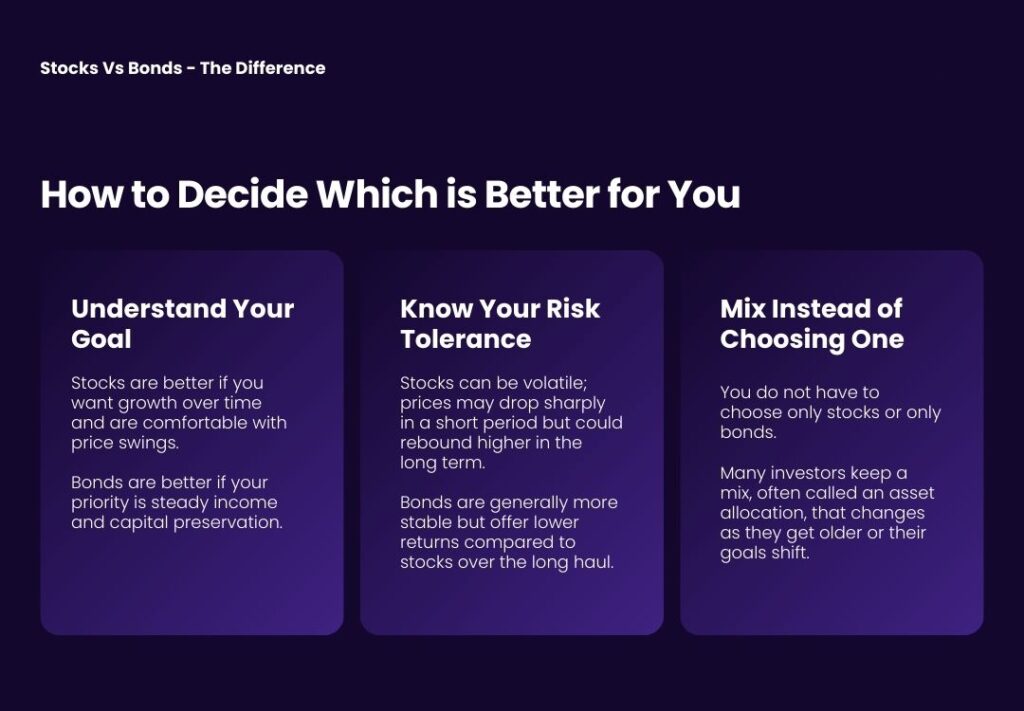
1. Understand Your Goal
Stocks are better if you want growth over time and are comfortable with price swings.
Bonds are better if your priority is steady income and capital preservation.
2. Know Your Risk Tolerance
Stocks can be volatile; prices may drop sharply in a short period but could rebound higher in the long term.
Bonds are generally more stable but offer lower returns compared to stocks over the long haul.
3. Consider Your Time Horizon
If you need the money in the next 1–5 years, bonds (or bond-heavy portfolios) are usually safer.
If you have 10+ years before you’ll need the money, stocks can make more sense because they have time to recover from market dips.
4. Look at Market Conditions
When interest rates rise, bond prices tend to fall, but yields for new bonds improve.
When the economy is strong, stocks often do well, but they can also be overpriced if hype is high.
5. Mix Instead of Choosing One
You do not have to choose only stocks or only bonds. Many investors keep a mix, often called an asset allocation, that changes as they get older or their goals shift.
Stocks or Bonds: Which Should You Choose?
The honest answer is you probably need a bit of both.
Stocks offer the potential for higher returns over time. They let your money grow and help you stay ahead of inflation, which eats away at your purchasing power.
While stocks can be more volatile, they are often the engine behind long-term wealth building.
Bonds, on the other hand, provide a level of safety and consistency.
They offer a steady income and help balance out the risk that comes with investing in stocks. When markets dip, bonds tend to hold their value better, giving your portfolio some much-needed stability.
As a beginner, you do not have to choose only one. Instead, think about how much of each makes sense for you right now.
And remember, it is okay for your mix to change over time as your life changes.
Advantages of Investing in Both
1. Balance Risk and Reward
Stocks can grow your money faster, but prices go up and down a lot.
- Bonds are steadier and protect your money better, but grow more slowly.
- Holding both helps you avoid putting all your eggs in one basket.
2. Steady Income and Growth
- Bonds provide regular interest payments, giving you a steady income.
- Stocks can pay dividends plus an increase in value, helping your wealth grow.
3. Diversification
When stocks drop, bonds sometimes hold steady or even go up. Owning both smooths out the bumps in your total investment value.
4. Match Different Financial Goals
Bonds help protect money you’ll need sooner (e.g., buying a house in a few years). Stocks help your money grow for long-term goals (like retirement).
5. Reduce Emotional Stress
Watching your stocks drop can feel scary.
Bonds in your portfolio can reduce how much your total investments fall during bad markets, helping you stay calm and avoid panic selling.
In short, owning both stocks and bonds can balance growth and stability.
How to Start Investing as a Beginner
Whether it is stock or bond, or any type of investment at all, this is how to get started:
1. Educate Yourself
Read books, blogs, and reputable financial news. Learn basic terms like dividends, interest rates, ETFs, and index funds.
2. Know Your Risk Tolerance
Ask yourself:
How would I feel if my investment lost 20% in a year? Am I investing for five years or 30 years?
Your answers guide your mix of stocks and bonds.
3. Start Small
You do not need millions to begin investing. Many platforms let you start with as little as ₦5,000 or $10. You can gradually add more as you learn
4. Diversify
Do not bet everything on one company or one bond issuer. Spread your investments across multiple stocks or bonds, or choose mutual funds or ETFs that do it for you.
5. Consider Professional Help
If you are unsure, seek help from a certified financial planner who can help build a strategy tailored to your situation.
Stocks can offer superior growth over the long term, but they demand the emotional resilience to withstand market swings.
Bonds bring stability and income, acting as a counterweight when equities stumble.
The smartest allocation is one that reflects your personal time horizon, cash flow needs, and ability to handle volatility.
[…] funds often focus on either stocks, bonds, or a mix of both, and knowing the difference between stocks and bonds can help you understand what you’re really investing […]