


Canada’s labour market continued to stabilize in November 2025, with the unemployment rate falling down to 6.5%, a 0.4-point drop from October. Although the job market remains challenging for many, November brought the second straight decline in youth unemployment and the third month of overall job gains, offering a much-needed boost in confidence heading into the winter.
Canada’s latest Labour Force Survey for November 2025 brings another month of optimism for job seekers. Employment rose by 54,000 jobs (+0.3%), marking the third month in a row of solid growth. This time, gains were led by part-time work (+63,000), while full-time employment held steady, continuing the change we’ve seen through the fall.
Youth employment saw the strongest turnaround, adding 50,000 jobs. Several key industries also helped lift national numbers, including health care and social assistance, accommodation and food services, and natural resources.
The national unemployment rate fell to 6.5%, down from 6.9% in October, a welcome sign after months of elevated levels earlier in the year. And a level Canada last saw in October 2024.
Canada’s strong November job numbers align with what Scotiabank calls a “remarkably resilient” labour market. With three months of major gains in a row, the bank says employers appear confident despite ongoing uncertainty around U.S. trade policy. Markets responded quickly – the Canadian dollar jumped, and investors now expect interest rates to remain stable before any potential increases in 2026.
While challenges remain, especially in sectors like retail, November’s results show that many parts of the economy are still creating opportunities for job seekers across Canada.
Key Takeaways
Here’s what the data is showing in this month’s
labour market data from Statistics Canada:
- Unemployment rate: 6.5%, down from 6.9% in October.
- Employment: +54,000 jobs, the third straight month of growth.
- Youth employment: +50,000 (+1.8%); youth unemployment fell to 12.8%.
- Part-time jobs: +63,000 (+1.6%); continues to outpace full-time growth.
- Wages: Average hourly earnings up 3.6% year-over-year to $37.00.
- Industries seeing gains:
- Health care & social assistance: +46,000
- Accommodation & food services: +14,000
- Natural resources: +11,000
- Industries seeing losses:
- Wholesale & retail trade: -34,000
- Top provincial gains: Alberta, New Brunswick, and Manitoba.
What you’ll find on this page
Regional Insights from the November 2025 LabourMarket Data
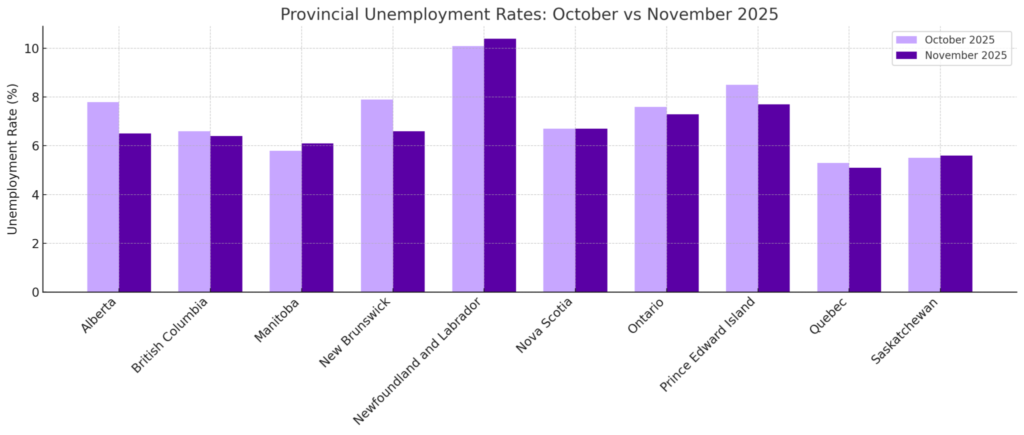
Provincial Unemployment Rates Across Canada in November 2025
Immigration Spotlight: Job Security Declines for Many Canadian Workers
Regional Insights from the November 2025 Labour Market Data
Employment performance varied across Canada in November, with several provinces seeing notable gains while others held relatively steady. The national unemployment rate fell to 6.5%, and although regional conditions remain mixed, many provinces experienced a more encouraging month than earlier in the year.
Alberta led November’s growth, adding 29,000 jobs (+1.1%)—its second significant increase in three months. The province’s unemployment rate dropped sharply to 6.5%, the lowest since March 2024, with both Calgary and Edmonton seeing improvements.
New Brunswick also saw solid gains, adding 5,500 jobs (+1.4%), while Manitoba saw a smaller but meaningful increase of 4,500 jobs (+0.6%). New Brunswick’s unemployment rate fell to 6.6%, and Manitoba’s held steady at 6.1%.
In contrast, Ontario and Quebec saw little change in overall employment for November, continuing a trend of slower growth through 2025. Ontario’s unemployment rate eased slightly to 7.3% as fewer people searched for work, while Quebec remained one of the strongest labour markets in the country at 5.1%.
Looking across Canada’s largest cities, both Toronto and Montréal saw small declines in unemployment, though labour market conditions continue to vary significantly by sector.
For newcomers, these regional differences highlight the importance of keeping an open mind about where to live and work. While large urban centres remain appealing, many smaller provinces and mid-sized cities are seeing stronger job creation – and may offer better opportunities outside the most competitive sectors.
Provincial Unemployment Rates Across Canada in November 2025
Here are the provincial unemployment rates in Canada, based on StatsCan data from November 2025:
- Alberta: 6.5%
- British Columbia: 6.4%
- Manitoba: 6.1%
- New Brunswick: 6.6%
- Newfoundland and Labrador: 10.4%
- Nova Scotia: 6.7% (unchanged)
- Ontario: 7.3%
- Prince Edward Island: 7.7%
- Quebec: 5.1%
- Saskatchewan: 5.6%
Changes in Provincial Unemployment from October to November 2025
Immigration Spotlight: Job Security Declines for Many Canadian Workers
Beyond headline employment numbers, the latest Labour Force Survey highlights a growing concern among workers: declining job security. In November 2025, nearly three-quarters of employees (73.6%) said they felt secure in their jobs, meaning they did not expect to lose their position within the next six months. While still a majority, this share has fallen by 4.1 percentage points since 2023, reflecting a more uncertain economic climate.
Younger workers continue to feel the most vulnerable. Just 65.3% of youth reported feeling secure in their job, compared with 74.9% of core-aged workers and 75.0% of those aged 55 to 69. Men were slightly less confident than women (72.5% vs. 74.7%), though declines were seen across all demographic groups.
Some industries experienced far sharper drops in perceived job security. Public administration recorded the largest decline, falling 12 points to 77.0% compared to 2023. Workers in educational services and professional, scientific and technical services also reported notable decreases. Employees in export-dependent industries – those most closely tied to U.S. demand were among the least confident overall, with only 68.5%feeling secure.
Confidence in employability has slipped as well. Only 42.8% of workers believe they could easily find another job with similar pay, down 6.2 points from 2023. The lowest levels of confidence were reported in public administration, information, culture and recreation, and manufacturing.
For newcomers, these changes serve as an important reminder that securing work is just one piece of long-term stability. Even in a labour market adding jobs, many workers are feeling less certain about the future of their employment. Exploring growing regions, diverse industries, and skills-focused pathways can help new arrivals navigate these uncertainties and build a more resilient career foundation in Canada.
Expert resources to help immigrants get jobs in Canada
Canada’s job market provides a wealth of opportunity for newcomers, but it is only that — an opportunity.
To take full advantage, recent and prospective immigrants can leverage free government-funded resources and programs. We recently partnered with Canada InfoNet, a government-funded pre-arrival employment support program, to bring you two expert guides on transitioning to a career in Canada:
How to find a career mentor in Canada
Transitioning to the Canadian job market
Our top job hunting resources
- Follow these steps if you want to find a job in Canada.
- Check out the latest job postings on the Jobs Board
- Foreign nationals require the proper immigration status to work in Canada. Understand your work permits options.
- Networking is one of the best ways to find career success. Here’s how to network successfully.