

Divorce is often approached from an emotional angle, heartbreak, anger, or relief, while the financial stakes are overlooked.
Yet, it is not just the end of a relationship; it is an economic earthquake.
However, beyond legal fees, divorce brings hidden costs and long-term consequences.
Savings can vanish, retirement funds may be split, and the family home, often the biggest asset, might need to be sold or refinanced.
Too often, discussions center on custody or blame, while the harsh financial reality is ignored until it is too late.
This article dives into the financial fallout of divorce, from legal costs and splitting assets to lifestyle changes and the often-overlooked ripple effects on your future financial security.
It also offers practical strategies to help you prepare and protect yourself during this life-changing transition.
Whether you are contemplating separation, already in the middle of proceedings, or simply curious about what divorce truly entails, understanding the financial side of divorce is crucial, as its financial aftermath can shape your life for years to come.
Immediate Costs of Getting a Divorce
1. Legal Fees
One of the most visible financial impacts of divorce is the cost of hiring lawyers.
According to data from the United States, the average cost of a divorce ranges from $7,000 to $15,000 per spouse.
Complex cases involving significant assets, custody battles, or disputes can easily exceed $30,000 or more.
Even if you choose a more amicable route, like mediation, you will still incur costs for legal documentation and professional guidance.
2. Court Costs
Court costs vary by jurisdiction but often involve:
- Filing fees
- Motion fees for specific requests
- Copying and mailing fees
- Costs for serving legal papers
While they may seem minor individually, they can accumulate quickly.
3. Mediation or Counseling Costs
Many couples attempt mediation to avoid the adversarial nature of court proceedings. Mediation costs vary widely, ranging from $3,000 to $10,000 depending on how many sessions are needed.
However, it is often cheaper than a prolonged court battle.
Therapy or counseling for spouses or children adds another layer of expense but can be invaluable for emotional well-being.
4. Splitting Assets
Equitable Distribution vs. Community Property
How assets are divided depends on state laws:
Community Property States (e.g., California, Texas): Generally, assets acquired during marriage are split 50/50.
Equitable Distribution States (most other states): Assets are divided fairly, but not necessarily equally. Factors like each spouse’s income, contributions to the marriage, and custody arrangements are considered.
Common Assets to Divide
Primary residence – Often the biggest asset. One spouse may “buy out” the other’s share, or the home may be sold and the proceeds split.
Retirement accounts – Dividing pensions, 401(k)s, and IRAs can trigger tax consequences. A special court order, called a Qualified Domestic Relations Order (QDRO), may be required.
Investments and savings – Brokerage accounts, savings accounts, and stocks must be divided, considering gains, losses, and tax implications.
Personal property – Cars, furniture, art, and collectibles.
Businesses – Dividing a business can be complex and often requires professional valuation.
5. Debts
Divorce does not erase debt. Joint credit cards, mortgages, car loans, and personal loans must also be split.
Even if a court assigns a debt to one spouse, creditors can still pursue either party if payments lapse.
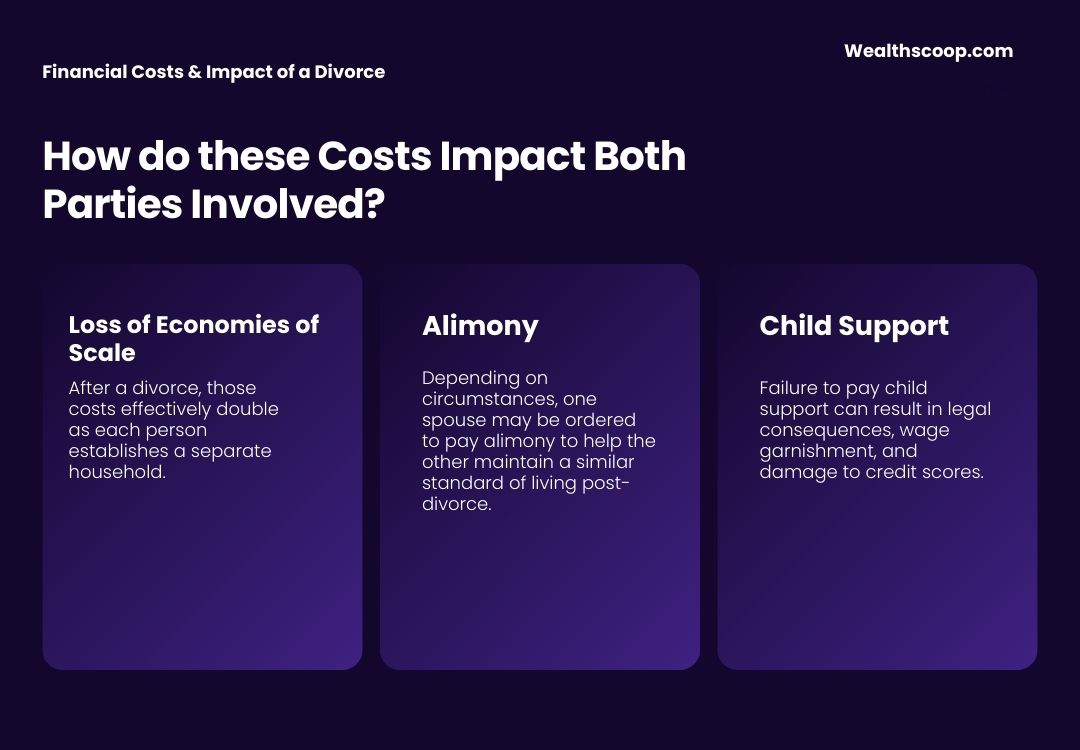
How do these Costs Impact Both Parties Involved?
Now that we have identified the costs of getting a divorce, let’s look at the impacts of these costs on both parties.
The impact includes:
1. Income Changes and Lifestyle Adjustments
This is one of the major impacts for many people going through divorce is how dramatically their income and, by extension, their lifestyle can change.
While married, couples often rely on two incomes to cover expenses and build their future.
Once divorced, that combined financial power is split, and suddenly each person has to make ends meet on a single income that may be significantly lower than what they are used to
2. Loss of Economies of Scale
Married couples benefit from shared expenses, a single mortgage, one set of utility bills, and shared childcare costs.
After a divorce, those costs effectively double as each person establishes a separate household.
3. Spousal Support (Alimony)
Depending on circumstances, one spouse may be ordered to pay alimony to help the other maintain a similar standard of living post-divorce.
Alimony laws vary significantly:
Temporary alimony – Supports a spouse during the divorce process.
Rehabilitative alimony – Helps a spouse gain education or job skills.
Permanent alimony – Less common today, but still awarded in long-term marriages.
4. Child Support
Child support is often mandatory and based on:
Each parent’s income
Number of children
Custody arrangements
Failure to pay child support can result in legal consequences, wage garnishment, and damage to credit scores.
5. Retirement Planning Disruptions
Divorce can severely disrupt retirement savings:
Pensions and retirement accounts are often split.
A spouse who was counting on joint retirement savings may find themselves needing to work longer.
Social Security benefits may change; divorced individuals may be eligible to claim spousal benefits if the marriage lasted at least 10 years.
Older couples divorcing (often called “gray divorce”) face unique risks because they have fewer working years left to rebuild savings.
How Divorce Affects Families

Divorce does not just affect the couple splitting up; it can have profound consequences on the children, both in the present and in shaping their future opportunities.
While parents do their best to shield kids from the stress of a breakup, the realities of divorce often ripple into many areas of children’s lives in ways families may not anticipate at first.
Divorce does not just affect parents; it can reshape children’s future in the following ways:
1. Emotional Strain – Children may feel confusion, sadness, or guilt, sometimes even blaming themselves for the separation.
2. Behavioral Changes – Younger kids might regress (bedwetting, clinginess), while teenagers could withdraw, act out, or take risks.
3. Financial Pressure – With household income split, there may be fewer resources for school, hobbies, or long-term savings like college funds.
4. Loss of Stability – Moving homes, adjusting to new routines, or changing schools can disrupt a child’s sense of security.
5. Parental Conflict – Ongoing tension between parents can create stress, leaving children feeling “caught in the middle.”
6. Social Effects – Friendships and social activities may suffer if the child feels embarrassed, distracted, or isolated.
The good news is, there are practical strategies you can use to ease the financial and emotional strain of divorce for both yourself and your children.
1. Prioritize Open Communication
Be honest (in age-appropriate ways) with your children about the changes happening. Reassure them it’s not their fault.
2. Practice Healthy Co-Parenting
Work with your ex to maintain consistency in routines, discipline, and rules. Children adjust better when both parents are on the same page.
3. Seek Professional Support
Therapy or counseling for both you and your children can provide tools for managing emotions and stress.
4. Maintain Financial Stability
Create a realistic post-divorce budget, protect savings, and plan for your children’s needs (education, healthcare, and daily expenses).
5. Avoid Putting Children in the Middle
Do not use them as messengers or involve them in parental conflicts. This reduces emotional stress.
6. Protect Routines and Stability
Try to keep school, activities, and living arrangements as consistent as possible to give children a sense of security.
7. Build a Support System
Lean on trusted family, friends, or support groups. Children also benefit from having caring adults around them.
8. Focus on Your Well-being
Take care of your mental and physical health. A stable, emotionally balanced parent provides children with the security they need.
Preparing for the unknown: Life after Divorce
While divorce is emotionally and financially painful, it can also be an opportunity for growth. Many people come out of it with a stronger sense of independence and control over their future.
Some key benefits include:
- Greater control over money – You can set a budget that reflects your own goals and values.
- Building personal credit – Managing accounts in your name helps strengthen credit and confidence.
- Redefining financial goals – Divorce offers a chance to reassess priorities, whether that means a new career, relocation, or fresh investment strategies.
This transformation requires planning, support, and sometimes professional guidance. But with the right approach, divorce can mark the beginning of a more financially secure and fulfilling chapter.
Ultimately, divorce may close one door, but it also opens another. It can be the start of a new season of self-discovery, resilience, and the chance to create a life built on your terms.