


Balancing a full-time job with the ambition to start a side hustle can feel overwhelming at first. Between commuting, meetings, and personal responsibilities, carving out time to launch a business may seem impossible.
Yet, countless people have successfully built thriving side hustles without quitting their 9–5. The key lies in smart planning, time management, and choosing the right type of hustle.
In this guide, we’ll walk through practical steps to help you start strong, stay consistent, and grow your side business without burning out.
1. Define Your Motivation and Long-Term Goals
Before you dive into any side hustle, you need clarity on why you’re doing it. Motivation is your fuel, and without a clear “why,” it’s easy to quit when things get tough.
Ask yourself:
- Do I need extra income to pay off debt or save for a big purchase?
- Am I testing the waters for a possible career change?
- Do I want more freedom and flexibility in the long run?
- Or is this simply about monetizing a passion project I already enjoy?
When you answer honestly, you’ll uncover your true driver. From there:
- Write down both short-term goals (like making an extra $500 per month) and long-term goals (like replacing your 9–5 income in 2–3 years).
- Keep your goals visible—on your phone wallpaper, vision board, or journal—so you’re reminded daily.
- Break down big goals into smaller milestones so you can celebrate progress along the way.
A side hustle without direction is just “extra work.” A side hustle with a purpose becomes a stepping stone to freedom.
2. Choose the Right Side Hustle for Your Schedule
Your side hustle must fit into your lifestyle, not the other way around. If you already work 40+ hours a week, you don’t need something that demands 30 more. Instead, look for hustles that are:
- Flexible: Work when you have free time (evenings, weekends, or during your commute if it’s remote).
- Scalable: Start small with one client or one product, then expand as your confidence and availability grow.
- Low risk: Avoid ventures that require huge upfront investments or long learning curves.
Good examples: freelance services (writing, design, consulting), tutoring, or social media management.
If you’re struggling with ideas, check out this list of low-risk service-based business ideas. It’s a practical starting point that helps you filter options by your skills and available time.
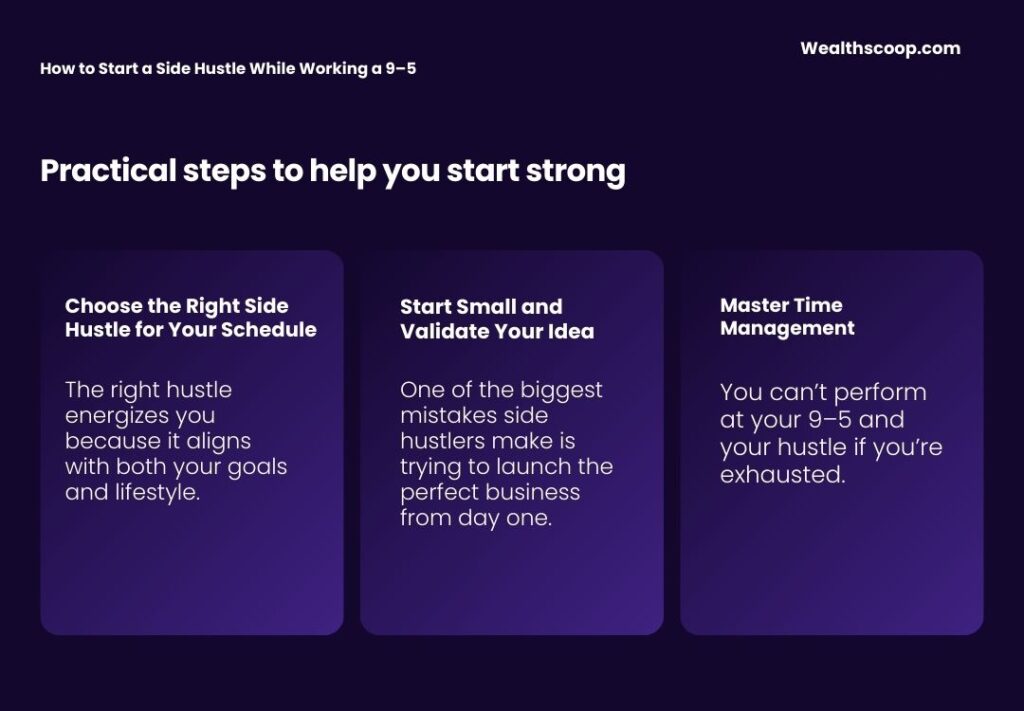
The wrong hustle drains you. The right hustle energizes you because it aligns with both your goals and lifestyle.
3. Start Small and Validate Your Idea
One of the biggest mistakes side hustlers make is trying to launch the perfect business from day one.
That’s a recipe for overwhelm. Instead, start with a minimum viable offer (MVO)—the simplest, most basic version of your product or service that solves a real problem.
Here’s how:
- Test your offer with a handful of clients. Offer discounted rates in exchange for feedback.
- Build a small portfolio. Case studies, testimonials, or before-and-after examples help you land better-paying clients later.
- Ask for honest feedback. Don’t be afraid of criticism—it sharpens your offer before you invest heavily.
This approach allows you to experiment without high risk. If your idea works, scale it. If not, tweak it or pivot entirely.
4. Master Time Management
Your biggest obstacle as a side hustler with a 9–5 is not ideas or money—it’s time. Managing your hours effectively is the difference between growth and burnout.
Practical tips:
- Set a schedule: Block 1–2 hours a day during weekdays and a 3–4 hour block on weekends. Treat it like a real appointment.
- Prioritize income-generating work: Focus on client projects, product sales, or outreach—not endless logo redesigns or “perfecting” your website.
- Leverage tools: Use productivity apps like Notion, Trello, or Google Calendar to keep everything in check. Automate small tasks where possible.
- Protect your energy: Schedule breaks and downtime. You can’t perform at your 9–5 and your hustle if you’re exhausted.
5. Manage Your Finances Wisely
Money is both the reason you’re hustling and the resource that keeps your hustle alive. To avoid stress:
- Separate finances: Open a dedicated account for your side hustle, even if it’s just a second checking account.
- Track everything: Use tools like Wave, QuickBooks, or even a simple spreadsheet to record income and expenses.
- Reinvest profits: Don’t splurge on every new dollar earned. Instead, put it into better tools, training, or marketing that will help your hustle grow.
- Plan for taxes: Side hustle income is still taxable. Set aside 15–25% of what you earn so you don’t get surprised later.
The goal isn’t just to earn more—it’s to keep more and use it strategically to build stability.
6. Stay Compliant and Professional
Many side hustlers overlook this part, but it matters. Just because your hustle is part-time doesn’t mean you can ignore the legal and professional side of things.
- Review your employment contract: Make sure your company allows outside work. Some industries have strict policies.
- Register your hustle (if needed): Depending on your location, you may need a business license or tax ID.
- Use contracts: Even simple agreements protect you when working with clients. Free templates are available online.
- Communicate professionally: Respond promptly, meet deadlines, and treat clients with respect—this builds reputation and referrals.
Acting professional from day one signals that you’re serious, which attracts higher-paying opportunities.
7. Scale at Your Own Pace
Not every side hustle needs to become a full-time business—and that’s okay. The beauty of side hustles is flexibility.
Options for scaling:
- Keep it small: Use it as a passion project or source of extra income alongside your 9–5.
- Grow gradually: Add more clients, increase prices, and invest in systems as your confidence grows.
- Go full-time: When your hustle income consistently matches or exceeds your salary, you’ll be in a strong position to transition.
Remember: Growth should feel sustainable, not suffocating. There’s no timeline—you set the pace.
Final Thoughts
Starting a side hustle while working a 9–5 isn’t easy—but it’s absolutely possible. With a clear plan, disciplined time management, and the right type of hustle, you can create new income streams without sacrificing stability.
If you’re still unsure which side hustle to start, check out this list of low-risk service-based business ideas to spark inspiration.
[…] you’ve chosen an idea, check out this step-by-step guide to balancing a full-time job with a side hustle so you can actually bring it to […]