


Life is uncertain, but insurance is certain.
Many people think of insurance as throwing money away, but it is not. Think of it as placing a soft landing for when you mistakenly trip and fall off a high ground.
Buying a new home, car, or starting a business requires insurance.
That brings us to the question
What Exactly Is Insurance?
Insurance is a financial agreement that protects you against unexpected financial losses.
In exchange for paying a regular fee (called a premium), the insurance company promises to pay for specific types of losses, damages, or expenses if they happen.
At its core, insurance does three things:
1. Protects you from financial disaster
Accidents, illness, natural disasters, or lawsuits can reduce your savings. Insurance shields you from massive costs you would otherwise have to pay out-of-pocket.
2. Transfers risk away from you
Instead of risking financial ruin alone, you share the risk with many others through the insurance pool. Everyone pays a little, so no one person has to pay a lot if disaster strikes.
3. Provides you peace of mind
Life is unpredictable. Insurance helps you sleep better, knowing you are covered if something goes wrong.
Insurance also helps with:
1. Compliance with Legal Requirements
Some insurance is required by law:
• Auto liability insurance is mandatory in most places if you drive.
• Workers’ compensation insurance is legally required for many businesses.
Without required insurance, you risk fines, license suspension, or lawsuits.
2. Protection of Your Family’s Future
If you pass away unexpectedly, life insurance helps ensure your loved ones aren’t left in financial hardship.
A life insurance payout can help pay off a mortgage or cover children’s education costs.
3. Protection of Your Assets
Insurance safeguards your belongings, home, or business investments from damage or theft.
4. Helping Your Businesses Survive Unexpected Events
Business insurance protects owners from losses that could otherwise shut down operations:
• Property damage
• Lawsuits
• Employee injuries
5. Helping you Make Big Purchases Possible
Lenders often require insurance before approving big loans:
• Mortgage lenders require homeowners’ insurance.
• Car loan providers may require full coverage auto insurance.
Without insurance, you may not get financing for major purchases.
6. Helping You Recover Faster After Loss
Insurance does not prevent bad events, but it ensures you can rebuild your life afterward.
Key Terms to Know Before Buying Insurance
Here is a crash course in key terminology:
Policy: The legal contract outlining what is and isn’t covered.
Premium: The regular payment you make to keep your insurance active.
Deductible: The amount you pay out-of-pocket before insurance kicks in.
Coverage Limit: The maximum amount the insurer will pay for a claim.
Exclusion: Things the policy specifically doesn’t cover.
Claim: A request you file for payment under your insurance policy.
Beneficiary: The person who receives payment in life insurance if you die.
Major Types of Insurance
Here are the main types of insurance that individuals and families should consider.
1. Life Insurance
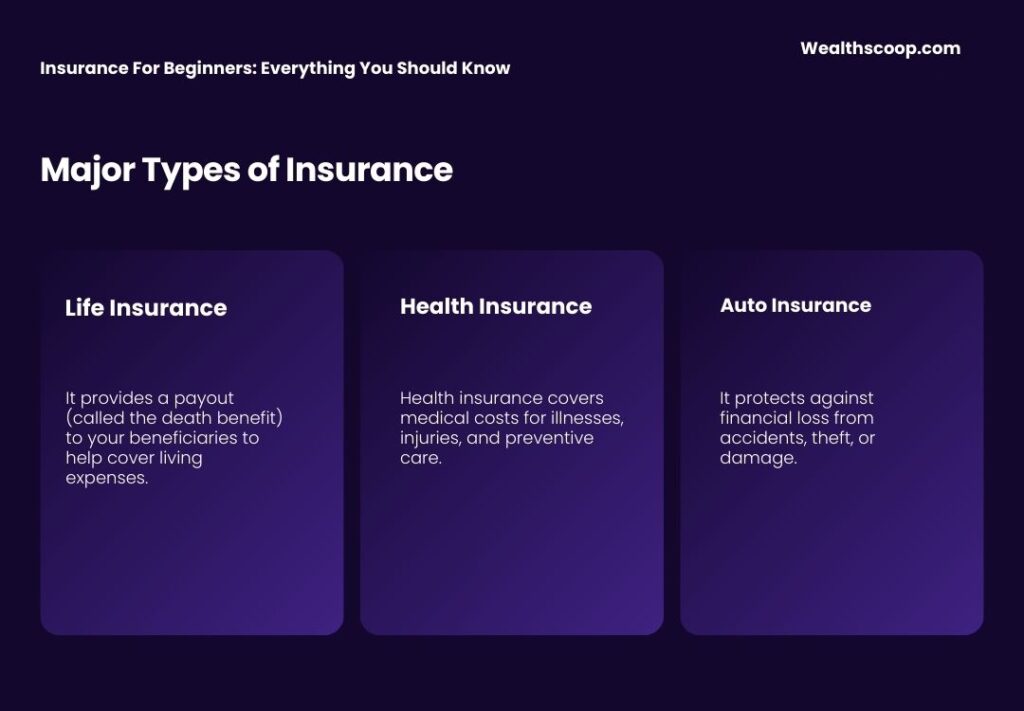
Life insurance protects your loved ones financially if you pass away. It provides a payout (called the death benefit) to your beneficiaries to help cover living expenses.
It helps cover:
- Funeral expenses
- Living costs for your family
- Mortgage payoff
- Children’s education costs
- Debts you leave behind
Life insurance is further subdivided into two categories, which are:
Term Life Insurance
This is the simplest and most affordable type of life insurance. You buy coverage for a specific period called a “term,” like 10, 20, or 30 years.
Key Features:
- Pays your beneficiaries a lump sum if you die during the term.
- No payout if you outlive the policy (coverage simply ends).
- Much cheaper than permanent insurance.
- No cash value savings component.
Permanent Life Insurance
Unlike term insurance, permanent life insurance never expires as long as you pay premiums. It also builds cash value, a savings-like feature you can access while you’re alive.
Some varieties of permanent life insurance include;
Whole Life Insurance
Whole life insurance is the most traditional type of permanent coverage.
Key Features:
- Coverage lasts your entire life.
- Premiums stay the same (level premiums).
- Builds cash value that grows at a guaranteed rate.
You can borrow against the cash value or withdraw funds (with some conditions).
Universal Life Insurance
Universal life insurance also offers lifetime coverage, but with flexible premiums and death benefits.
Key Features:
- Flexible premiums: pay more or less, depending on your finances.
- Adjustable death benefit.
- Cash value earns interest (based on market rates, sometimes with minimum guarantees).
Variable Life Insurance
Variable life insurance combines lifelong coverage with investment options.
Key Features:
- Part of your premiums go into investment accounts (stocks, bonds, mutual funds).
- Death benefit and cash value can increase or decrease based on investment performance.
- Higher risk than other permanent policies.
Indexed Universal Life Insurance (IUL)
IUL is a variation of universal life that ties cash value growth to a stock market index (like the S&P 500) but with some protection against losses.
Key Features:
- Cash value growth is linked to an index’s performance.
- Gains are capped, but there’s often a guaranteed floor (e.g., 0%) to protect against losses.
- Flexible premiums and death benefits.
2. Health Insurance
Health insurance covers medical costs for illnesses, injuries, and preventive care.
Health insurance plans typically include:
- Doctor visits
- Hospital stays
- Surgeries
- Emergency care
- Prescription drugs
- Mental health services
3. Auto Insurance
Auto insurance is mandatory in most places if you drive. It protects against financial loss from accidents, theft, or damage.
It covers:
- Liability Coverage: Pays for damage or injuries you cause to others.
- Collision Coverage: Pays to repair your car after an accident.
- Comprehensive Coverage: Pays for non-collision events like theft, fire, or weather damage.
- Uninsured Motorist Coverage: Protects you if the other driver has no insurance.
4. Homeowners’ Insurance
Homeowners’ insurance protects:
- Dwelling: Your house structure.
- Personal Property: Furniture, electronics, clothes.
- Liability: Injuries on your property.
- Additional Living Expenses: Hotels or rentals if your home becomes unlivable.
5. Renters’ Insurance
Renters’ insurance is essential for tenants. It covers:
- Personal property inside your rental.
- Liability coverage if someone is injured.
- Additional living expenses if your rental becomes uninhabitable.
6. Disability Insurance
Imagine losing your paycheck for six months or longer due to illness or injury. Disability insurance replaces part of your income, helping cover:
- Rent or mortgage
- Food and utilities
- Medical bills
- Short-Term Disability: Covers weeks to a few months.
- Long-Term Disability: Covers months to years or until retirement.
7. Business Insurance
Businesses face unique risks. Insurance helps them survive:
- Property Insurance: Covers damage to buildings, equipment, and inventory.
- Liability Insurance: Covers legal costs if someone sues your business.
- Workers’ Compensation: Required in most places for employee injuries.
- Business Interruption Insurance: Covers lost income during forced closures.
- Cyber Insurance: Covers hacking, ransomware, and data breaches.
How Insurance Premiums are Calculated
Insurance companies use professionals skilled in statistics to analyze risk and predict how many claims will happen each year.
Insurance companies use complex math to decide how much to charge you. Here’s what they consider:
- Your age (younger people pay less for life insurance but might pay more for auto insurance)
- Health history (affects life and health premiums)
- Occupation (dangerous jobs mean higher premiums)
- Location (storm-prone areas have higher home insurance)
- Driving record (accidents mean higher auto rates)
- Value of insured items (the more expensive your property, the higher the cost)
Common Exclusions and Limitations on Insurance
It is critical to read your policy carefully.
Common things not covered include:
- Wear and tear or maintenance issues.
- Intentional damage or fraud.
- Certain types of natural disasters (unless you add coverage).
- Undisclosed pre-existing conditions.
How to Choose the Right Insurance for You
Choosing insurance does not have to be overwhelming if you follow the following steps:
1. Assess Your Needs:
Do you have dependents? A mortgage? A car? A business?
2. Know Your Budget:
Find a balance between affordable premiums and adequate coverage.
3. Compare Policies:
Get multiple quotes and check reviews of insurance companies.
4. Understand Exclusions:
Know what’s NOT covered.
5. Review Regularly:
Life changes (marriage, kids, new job) might require new coverage.
Get that insurance today
“Insurance is not just about protecting things it is about protecting your future. One unexpected event can undo years of hard work.” Michael Turner, Certified Insurance Specialist
Insurance won’t prevent storms, accidents, or illness. But it ensures you won’t lose everything when disaster strikes.
Think of insurance not as “wasted money,” but as a financial lifeline. It is the silent shield standing between you and financial ruin.
It is an act of responsibility, love, and foresight because the cost of being unprepared is always greater than the cost of being protected.
Get insurance not just because it is smart, but because it is the one decision you will never regret when it matters most.