


At some point, almost everyone faces the classic money dilemma: should you pay off debt first or start investing?
Financial gurus champion the peace and freedom of being debt-free, while seasoned investors rave about the magic of compound interest and insist you begin as early as possible.
Both sides sound convincing, so who is right?
Your decision will hinge on factors such as the type of debt you carry, the interest rate you are paying, your financial goals, your risk tolerance, and even how debt affects you emotionally.
In reality, money choices aren’t just about numbers; they are also about peace of mind. Let us break it down so you can choose the path that truly works for your finances and your life.
First of all, you need to understand the basics.
Debt vs. Investing
Debt is money you owe, often with interest, such as credit cards, student loans, car loans, or mortgages. It takes money out of your pocket every month until it is repaid.
Investing, on the other hand, is putting your money into assets like stocks, bonds, real estate, or mutual funds with the expectation that they will grow in value or produce income over time.
One reduces your obligations; the other builds your wealth. Knowing how each works is the first step to making the right choice.
Different types of debt you need to know about
1. High-Interest “Bad” Debt
High-interest debt is money you owe that comes with a very high cost to borrow, meaning the lender charges you a high interest rate, often 15% to 40% or more each year.
Suze Orman, an investment expert, advised that“High-interest debt is an emergency; you pay it off first. But if your loan rate is low and you have an emergency fund, you can invest while you pay it down.”
Examples include:
Credit cards – If you do not pay off the full balance each month, you are charged interest on what you still owe. Credit card rates often range from 20% to 30% or higher.
Payday loans – Short-term loans with extremely high fees and interest. Annual rates can exceed 300%, trapping people in a cycle of debt.
Personal loans from finance companies – Some charge high rates, especially if your credit score is low.
The problem with high-interest debt is that it grows quickly over time. Even small balances can balloon because interest keeps adding up, making it harder to pay off.
These type of loans carries interest rates of 15%–40% or higher.
Rule of thumb: Pay off these types of loans first because no investment reliably beats those rates.
2. Moderate-Interest Debt
Moderate interest debt is money you borrow at an interest rate that is higher than cheap loans like mortgages, but lower than expensive debt like credit cards. Typically, moderate-interest rates range from about 5% to 12% annually.
Examples include:
Personal loans – Used for things like consolidating debt, home repairs, or big purchases. Rates vary based on your credit score.
Auto loans – Car loans often fall in this range, depending on your credit and the lender.
Some private student loans – Especially if you have good credit, these may have moderate rates.
Unlike high-interest debt, moderate-interest debt does not grow extremely fast, but it still costs you money over time.
With moderate-interest debt, whether to pay it off quickly or invest is a clear-cut decision.
Paying it off is a safe, guaranteed “return.”
Investing might earn you more (7–10% or higher), but it carries risk.
Moderate-interest debt is not financially crippling like high-interest debt, but it is still worth managing carefully.
3. Low-Interest Debt
Low-interest debt is money you borrow at relatively low annual interest rates, usually around 2% to 5%. It’s often considered “good debt” because it costs much less to carry over time.
Examples include:
Mortgages – Home loans often have low rates, especially if you have good credit. For instance, a mortgage might have an interest rate of 4% or lower.
Federal student loans – Many government-backed student loans have interest rates between 3% and 5%.
Business loans – Some small-business loans or lines of credit come with low rates if your credit and business finances are strong.
Low-interest debt is generally not urgent to pay off quickly because the interest cost is manageable, and you might earn more by investing instead.
However, some people still prefer paying off low-interest debt early for peace of mind and financial security. In short, low-interest debt is the least financially harmful type of debt. It is often okay to keep it while investing for your future, as long as you’re comfortable.
Crunching the Numbers: The Math Behind Your Decision
Let us get practical.
Here is how to decide whether paying off debt or investing first makes financial sense.
Step 1: Know Your Debt Interest Rates
List every debt you have and its interest rate.
Example:
Credit card: $5,000 at 25%
Personal loan: $10,000 at 10%
Mortgage: $80,000 at 5%
Mortgage: ₦8,000,000 at 5%
Step 2: Estimate Investment Returns
When deciding whether to pay off debt or invest, you need to estimate how much money your investments might earn over time. This helps you compare the potential benefits of investing against the cost of your debt.
But here’s the key: Be conservative in your estimates.
People often hear stories of big stock market wins or flashy investment returns. But in reality, investing doesn’t guarantee fast profits—and returns can swing wildly from year to year.
Step 3: Compare Rates
Once you know your debts and estimate your potential investment returns, the next step is to compare the two rates side by side.
This helps you figure out which financial move to take, either paying off debt or investing. Choose the one that saves or earns you more money in the long run.
Ask yourself the following questions?
Is my debt interest rate higher than my expected investment return?
If yes → Pay off debt first.
If no → Consider investing while making minimum debt payments.
Factors to consider when deciding to pay off a loan or invest
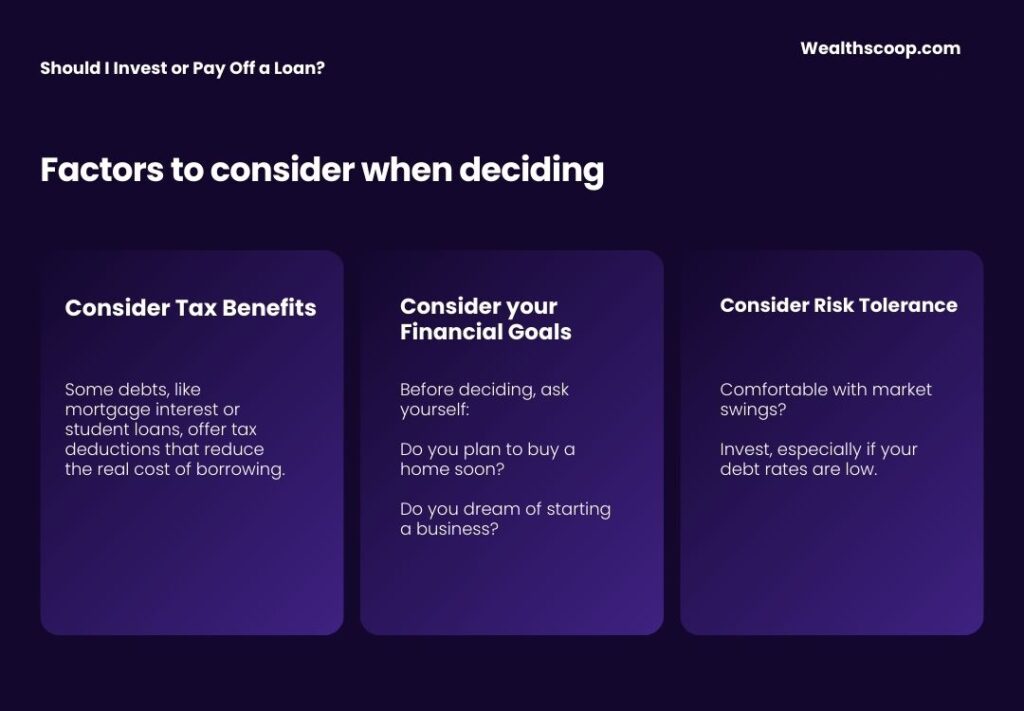
1. Consider Tax Benefits
Some debts, like mortgage interest or student loans, offer tax deductions that reduce the real cost of borrowing.
For example:
Mortgage interest might be tax-deductible.
Student loan interest can sometimes reduce your taxable income.
Check your local laws wherever you live to see how tax rules apply. These savings could tilt the scales in favor of investing instead of rushing to pay off low-interest debt.
2. Consider your Financial Goals
Before deciding, ask yourself:
Do you plan to buy a home soon?
Are you saving for your kids’ education?
Do you dream of starting a business?
Do you want to retire early?
These goals affect whether freeing up cash flow (by paying debt) or investing for growth should take priority.
3. Consider Time Horizon
The longer your investing timeline, the more likely investing pays off, because of compounding.
If you are close to retirement, the safety of being debt-free might outweigh potential investment gains.
4. Consider Risk Tolerance
Investing always carries risk. Paying off debt, on the other hand, is a guaranteed return equal to your interest rate.
Risk-averse? Pay off debt faster.
Comfortable with market swings? Invest, especially if your debt rates are low.
Invest or Pay Off Loans?
The “right” choice depends on you; there is no universal rule because everyone’s financial picture and emotions are different.
If in doubt, run the numbers or talk to a financial advisor who can help tailor a plan for your situation.
Debt and investing are two sides of the same financial coin. Choosing which to prioritize is one of the most personal financial decisions you will ever make.
High-interest debt? Pay it off first.
Low-interest debt? Consider investing.
Not sure? Do a hybrid plan.
In the end, your financial freedom and peace of mind matter most. Whether you pay off debt, invest, or both, the key is to act intentionally and keep moving toward your financial goals.