


Managing your finances goes beyond budgeting and saving—it also involves understanding how lenders, landlords, and even employers view you financially.
At the center of this is your credit report. If you’ve ever applied for a loan, credit card, or even a new apartment, chances are your credit report was reviewed.
But here’s the thing: most people don’t really understand what’s in their report or how to fix issues when they arise.
This guide breaks it all down so you can confidently read your credit report, understand what it means, and take action to improve it.
How to Read Your Credit Report
When you first open your credit report, it can feel like staring at a wall of numbers, dates, and financial jargon.
But don’t worry—once you know what each section means, the whole thing starts to make sense. Let’s walk through the major parts of your credit report together and talk about what to look out for.
1. Personal Information
This is the very first section you’ll see, and it’s all about confirming your identity. It usually includes:
- Your full name (and any variations or aliases): For example, if you’ve gone by “John Smith Jr.” or “Johnny Smith,” both might show up.
- Social Security number or national ID (partially masked): Only the last few digits usually display, but it’s still worth confirming.
- Current and past addresses: This may include every address you’ve lived at for the past several years.
- Employment history: Not every report includes this, but if it does, it may list your current or past employers.
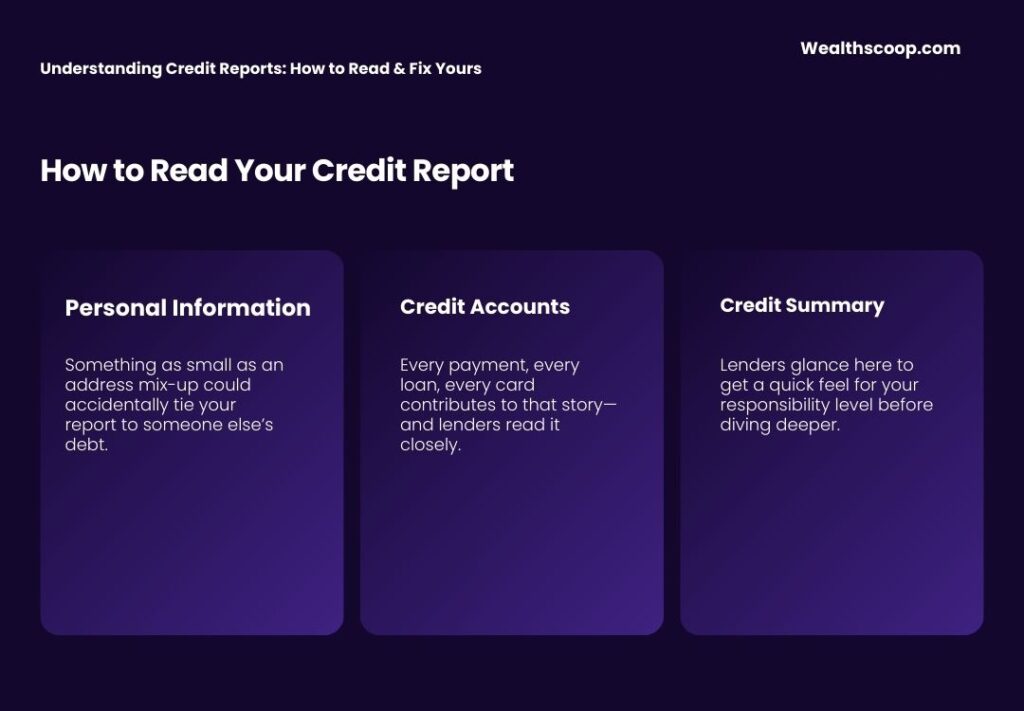
Why this matters: Errors in this section are more common than you’d think. Something as small as an address mix-up could accidentally tie your report to someone else’s debt.
That’s why it’s important to slow down and make sure all your details match your actual history. If you spot a mistake—say, an address you’ve never lived at—that’s a red flag and should be disputed immediately.
2. Credit Accounts (Tradelines)
This is the heart of your credit report, and honestly, it’s where lenders pay the most attention. Here you’ll see a detailed list of all the accounts you’ve had, including:
- Account type: Credit cards, personal loans, auto loans, student loans, mortgages—basically any kind of debt you’ve taken on.
- Lender’s name: Who issued the credit (for example, Chase Bank, Capital One, or your local credit union).
- Date the account was opened (and closed if applicable): This helps determine how long you’ve had credit, which impacts your credit score.
- Credit limit or loan amount: For revolving accounts like credit cards, this is your limit. For loans, it’s the original loan balance.
- Payment history: This is a record of whether you’ve been paying on time every month or if you’ve missed payments.
- Current balance: How much you still owe right now.
What to keep an eye on:
- Late or missed payments: Even one can ding your score and stay on your report for years.
- Accounts you don’t recognize: If a credit card or loan you never opened appears, that could be a sign of identity theft.
- Closed accounts showing as open: Sometimes reports aren’t updated correctly, so double-check this.
Think of this section as the story of how you’ve handled debt. Every payment, every loan, every card contributes to that story—and lenders read it closely.
3. Credit Inquiries
This section tells you who has been peeking at your credit. There are two types of inquiries, and it’s worth knowing the difference:
- Hard inquiries: These happen when you apply for something like a credit card, mortgage, or car loan. Each hard inquiry is recorded, and too many in a short time can signal to lenders that you’re desperate for credit, which could lower your score slightly.
- Soft inquiries: These are harmless. They happen when a company checks your credit to pre-approve you for an offer, or when you check your own report. Soft inquiries don’t affect your score.
What to watch for:
If you notice several hard inquiries from lenders you don’t remember applying with, that could mean someone is trying to open accounts in your name. It’s worth following up on these quickly to make sure your identity is safe.
4. Public Records & Collections
This part of your report isn’t fun to look at, but it’s important. It includes serious financial events such as:
- Bankruptcies (which can stay on your report for up to 10 years)
- Foreclosures (if you’ve lost a home to unpaid mortgage debt)
- Tax liens (unpaid taxes that the government has claimed against you)
- Accounts in collections (debts you didn’t pay that a lender turned over to a collections agency)
What to keep an eye on:
- Old items that should have fallen off: Most negative marks drop off after 7 years, except for bankruptcies. If something older than that is still showing, you should dispute it.
- Debts you’ve already paid: Sometimes a paid-off collection account still shows as unpaid. That’s an error you’ll definitely want to correct.
This section has the biggest impact on your ability to borrow, so review it carefully.
5. Credit Summary
Finally, you’ll see a summary that ties everything together. It usually includes:
- Total number of accounts: How many credit cards, loans, and other accounts you’ve ever had.
- Outstanding balances: How much debt you currently owe across all accounts.
- Overall payment history: A snapshot of whether you generally pay on time or not.
This is essentially your financial “at-a-glance.” Lenders glance here to get a quick feel for your responsibility level before diving deeper.
Think of it as the back-cover summary of your financial story—it doesn’t have every detail, but it gives a clear picture of how well you’re managing money.
How to Fix Errors on Your Credit Report
1. Identify the Mistake
The first step is slowing down and really combing through your report. Don’t skim—read line by line. Highlight anything that doesn’t look right, such as:
- An address you’ve never lived at
- An account you don’t recognize
- A balance that doesn’t match what you know you owe
- A late payment that you’re certain you paid on time
Think of this like proofreading an important document. Even a single typo (or in this case, a wrong number) can make a big difference.
2. Gather Evidence
Once you know what’s wrong, back yourself up with proof. The stronger your evidence, the faster and smoother the correction process will go. Depending on the mistake, this might include:
- Bank statements showing a payment was made
- Receipts or confirmation numbers from online payments
- Letters or emails from the lender confirming your account status
- Proof of address if the issue is tied to your personal information
It helps to keep everything organized—create a folder (digital or physical) where you store all your supporting documents.
3. File a Dispute with the Credit Bureau
Now it’s time to take action. You can dispute errors directly with the credit bureau (Equifax, Experian, TransUnion, or whichever bureau’s report has the mistake).
Most of them allow you to file disputes online, which is faster, but you can also do it by mail if you prefer paper records.
When you file, be clear and specific.
For example, instead of saying “This balance is wrong,” say “This account shows a balance of $2,000, but I paid it off in March 2024. See attached bank statement dated March 15, 2024.” The clearer you are, the easier it is for the investigator to confirm your claim.
4. Contact the Lender or Creditor
Don’t stop with the credit bureau—go straight to the source, too.
If the mistake involves a bank, credit card company, or collection agency, reach out and let them know what’s wrong. Sometimes the lender has to update their own records before the credit bureau can fix your report.
This is especially important if it looks like fraud. If someone has opened an account in your name, you’ll need to contact the lender right away to shut it down and prevent further damage.
5. Follow Up
Here’s the part most people forget: following up. Credit bureaus usually have 30–45 days to investigate your dispute and get back to you.
During this time, they’ll reach out to the lender, verify your claim, and update your report if necessary.
When the process is done, you’ll receive the results in writing. If the bureau agrees with you, the error will be corrected, and you’ll often see an immediate boost in your credit score.
If they disagree, you still have the right to add a short statement to your credit report explaining your side of the story.
Final Thoughts
By knowing how to read it and how to fix errors, you take charge of your financial story. Instead of letting lenders define you, you define yourself through better money habits.
Think of your credit report as a mirror. It reflects your financial past, but it doesn’t lock you into it. With patience and strategy, you can shape a stronger financial future.